
Metaphor and Alchemy
A Further Defense

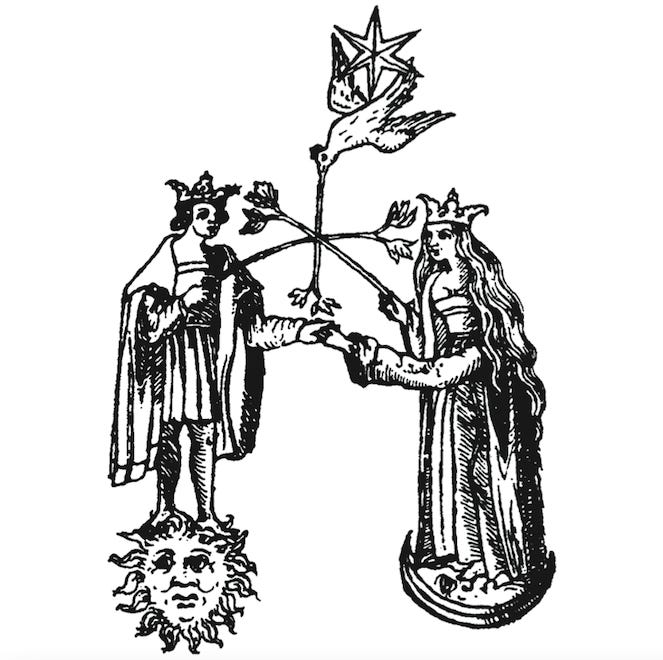
In my past article on alchemy, I attempted to explain the framework of the practice as symbolically Christian. Meaning to leave my defense there, I was in the depths of planning a further study of alchemy, this time in C.S.Lewis’s works, when an article was brought to my attention about how alchemy is dangerous for Christians, even if thought of purely in a symbolic context. Yes, alchemy is often deeply religious, the author agreed, but is that necessarily a good thing? Is it not through Christ’s Blood that we are purified and receive salvation, not through contemplating symbols and the philosopher’s stone?
The questions posed show an incomplete understanding of metaphor and symbolism. Acting as if symbolic alchemy disconnected from Christ, something working on its own and an “alternative path” to salvation, is indeed wrong, even if it remains something we only look for while reading literature (the context in which I write). Creation can not exist apart from God, it is impossible. In the same way, symbols disconnected from the transcendent and divine become one-dimensional and cannot exist. When Christ compares Himself to a tree or a rock it is not because He looked around at the moment and decided they had characteristics that would help explain His. No, when He created the heavens and the earth He put those characteristics in them so that we might behold and be reminded of Christ. Along this vein, St. Augustine in On Christian Doctrine, gives several examples on how understanding nature is often crucial for understanding parts of the Bible and how Christians should act:
“An ignorance of things makes figurative expressions obscure. When we are ignorant of the natures of animals, or stones, or plants, or other things which are often used in the Scriptures for purposes of constructing similitudes. Thus the well-known fact that a serpent exposes its whole body in order to protect its head from those attacking it illustrates the sense of the Lord’s admonition that we be wise like serpents. That is, for the sake of our head, which is Christ, we should offer our bodies to persecutors lest the Christian faith be in a manner killed in us, and in an effort to save our bodies we deny God.”
(On Christian Doctrine: pp. 50-51)
This understanding is not isolated to Christianity, it is only since the enlightenment that man has managed to look up at a tree and see nothing more than a clump of cells. Mircea Eliade in The Sacred and the Profane, his book on religion, comments:
“It could be said that the very structure of the cosmos keeps memory of the celestial supreme being alive. It is as if the gods had created the world in such a way that it could not but reflect their existence; for no world is possible without verticality, and that dimension alone is enough to evoke transcendence.”
(The Sacred and the Profane, p. 129)
The remark that it is through Christ’s Precious Blood that we are purified, not through contemplating symbols such as alchemy, is completely valid and true. But alchemy is not an alternative way. It is a symbolic, concise version of the path that already exists, and it is still through Christ’s sacrifice that we are saved. In literature, the Philosopher’s Stone actually represents Christ’s blood! A notable example of this is Parzival, a Germanic Arthurian poem of the 13th century where the hero finds a red stone described similarly to the Philosopher’s Stone (down to granting eternal life) instead of the traditional Holy Grail.
As I noted in my introductory post, following a quote from Shakespeare’s Window into the Soul by Martin Lings, the medieval symbolism helps make the world smaller so that we can see more of it and understand it better. Especially in the modern age, we have a tendency to zoom in too much on a particular thing that we forget its context and forget that it is connected to a language of symbols that point to the divine.